
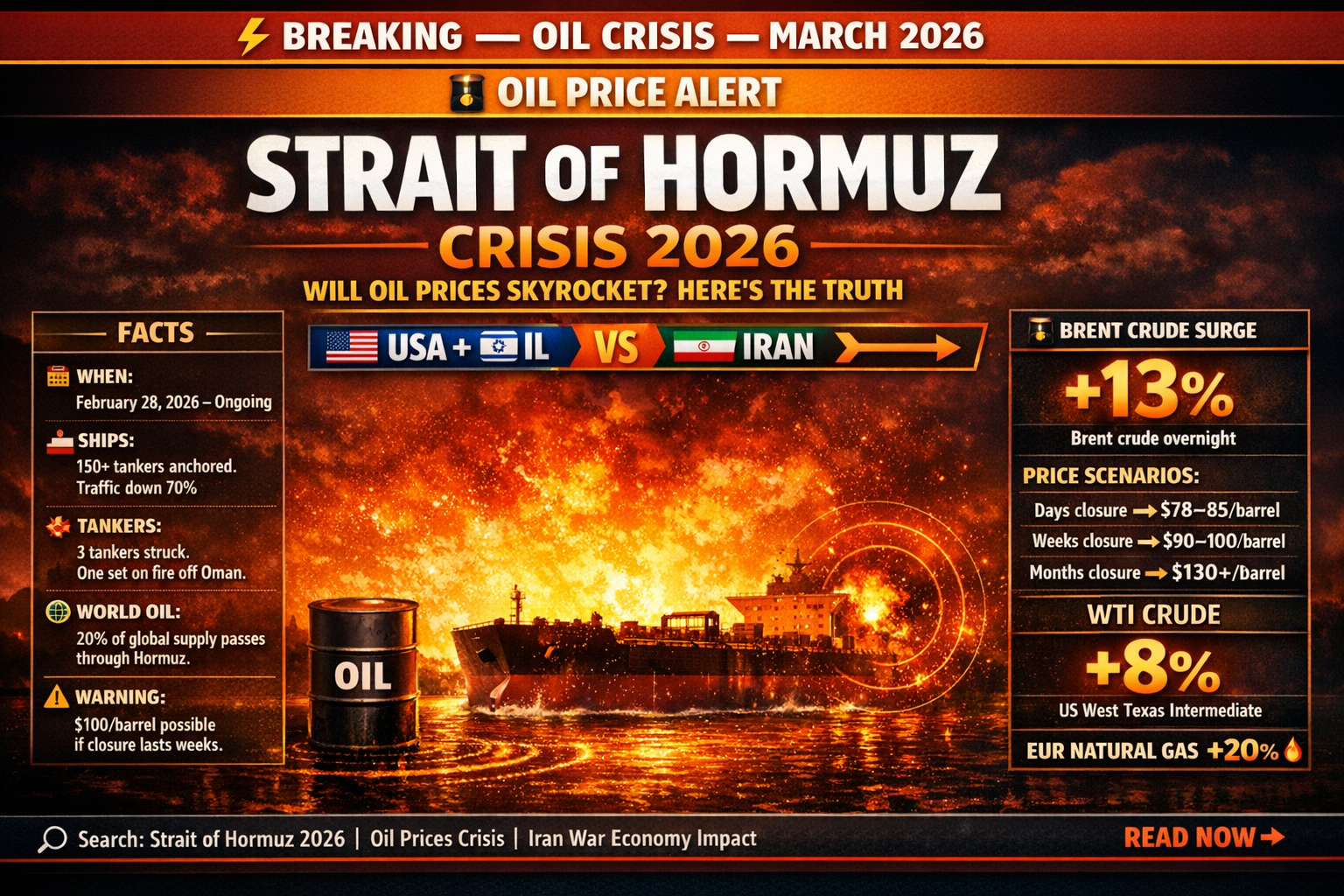
The short answer: Oil prices have already surged up to 13%. Analysts warn they could hit $100 per barrel — or beyond — if the world’s most critical oil shipping lane stays shut. Here is everything you need to know, explained simply.
What Is the Strait of Hormuz?
The Strait of Hormuz is a narrow strip of water — just 21 miles wide at its narrowest point — sitting between Iran and Oman at the mouth of the Persian Gulf.
Despite its small size, it is the single most important energy chokepoint on the planet.
The strait facilitates the transit of around 20 million barrels of oil per day, representing roughly 20% of global seaborne oil trade, primarily from producers like Saudi Arabia, the United Arab Emirates, Iraq, and Qatar.
In other words: 1 out of every 5 barrels of oil the world uses passes through this narrow gap.
And right now, it is effectively closed.
What Triggered the 2026 Strait of Hormuz Crisis?
The crisis began on February 28, 2026, following joint military strikes by the United States and Israel on Iran under Operation Epic Fury, which resulted in the reported killing of Iran’s Supreme Leader Ali Khamenei.
Iran’s response was swift. After coming under attack, Iran appeared to exercise one of its key retaliatory options — putting a squeeze on the strategic Strait of Hormuz. Ships reported hearing a radio broadcast purporting to come from the Iranian navy announcing that transit through it was banned.
Although Iran did not formally declare a blockade, the threats led to an effective closure, with ship-tracking data showing a 70% reduction in traffic. At least three tankers were struck near the strait, including one off Oman that was set ablaze.
How Bad Is the Shipping Disruption Right Now?
The situation on the water is severe.
At least 150 tankers, including crude oil and liquefied natural gas vessels, have dropped anchor in open Gulf waters beyond the Strait of Hormuz.
The Strait is not formally closed, but commercial operators, major oil companies, and insurers have effectively withdrawn from the corridor — creating a de facto closure for most of the global shipping community, comparable in character to the Red Sea disruption but with far larger volumes at stake.
After three tankers were hit over the weekend, shippers are now being extremely cautious. The biggest issue right now is how Asian refiners will actually receive their volumes from the Middle East.
Major shipping companies including Maersk and Hapag-Lloyd suspended transits through the strait and related routes like the Red Sea, forcing reroutes around Africa’s Cape of Good Hope — adding weeks to transit times and increasing costs significantly.
What Has Happened to Oil Prices?
Markets reacted immediately and violently.
Brent crude prices hit a new 52-week high on Monday, rising 7.6% to reach $78.41, while US West Texas Intermediate prices rose more than 7.4% to $72.01. Global oil majors traded higher, with Exxon Mobil up 4.1% in pre-market trading and Chevron up 3.9%.
Brent crude rose by up to 13% to $82 per barrel amid fears of prolonged supply shortages.
It is not just crude oil either. European natural gas markets surged more than 20%, as the Strait is also a key chokepoint for liquefied natural gas used to heat homes and generate electricity.
Could Oil Hit $100 Per Barrel?
This is the question every investor, government, and household is asking right now.
Analysts have warned that prices could top $100 a barrel if oil trade is disrupted for a prolonged period, or if the war spills over into neighbouring countries and destroys oil infrastructure.
One expert from the International Crisis Group put it bluntly — closure of the Strait would disrupt roughly a fifth of globally traded oil overnight, and prices would not just spike, they would gap violently upward on fear alone. The shock would reverberate far beyond energy markets, tightening financial conditions, fuelling inflation, and pushing fragile economies closer to recession within weeks.
This conflict presents a more severe supply picture than the June 2025 war. The prior conflict involved symbolic strikes and coordinated warnings. This one does not — physical supply is being disrupted in real time.
Which Countries Are Most Affected?
🇨🇳 China, 🇮🇳 India, 🇯🇵 Japan, 🇰🇷 South Korea — Most Vulnerable
China, India, Japan and South Korea combined accounted for 69% of all crude oil and condensate flows through the strait last year. Their factories, transport networks and power grids depend on uninterrupted Gulf energy.
Asian economies would be left particularly exposed if the Strait were closed. Their scramble to secure oil from other sources could drive global prices even higher. Since oil is a global, fungible commodity, a disruption anywhere affects prices everywhere.
🇪🇺 Europe — Natural Gas at Risk
83% of LNG volumes moving through the Strait are destined for Asian markets but supply tightening in Asia forces European buyers to compete harder for remaining LNG — pushing European gas prices sharply higher.
🇮🇳 India — Double Threat
India faces a unique challenge: it imports the majority of its crude oil from the Gulf, and millions of Indian workers in the UAE, Saudi Arabia, Kuwait, and Oman are directly in the conflict zone.
Can Saudi Arabia and OPEC Save the Day?
There are some alternative routes, but they are limited.
Saudi Arabia’s East-West Pipeline and the UAE’s Fujairah pipeline offer partial alternatives, but terminal infrastructure limits throughput. These routes could sustain a portion of displaced volume but would not offset a full Strait closure.
OPEC+ pledged to increase output by 206,000 barrels per day to help mitigate shortages — but analysts note this is a fraction of what would be needed if the Strait stays shut.
One critical constraint is that a significant portion of Gulf spare capacity cannot reach global markets if the Strait of Hormuz remains inaccessible.
Can Iran Actually Close the Strait Permanently?
Analysts say it is unlikely that the Strait would be closed altogether, as the US and Israel have superior military power to ultimately neutralise Iran’s ability to completely shut off the waterway. The bigger risk comes from one-off attacks on individual vessels passing through the area — which are far more difficult to prevent.
A prolonged disruption — which accommodates giant tankers ferrying oil and gas from the Middle East to China, Europe, the US and other major consumers — would trigger a spike in oil prices and potentially destabilise the global economy.
The critical variable: duration. A few days of disruption is already priced into markets. Weeks or months would be a different story entirely.
What Does This Mean for Petrol / Gas Prices at the Pump?
If you fill up a car, heat your home with gas, or buy products that require transport — this crisis affects you directly.
Here is what to expect based on different scenarios:
| Scenario | Brent Price Estimate | Impact on You |
|---|---|---|
| Strait reopens within days | $78–85/barrel | Petrol prices rise modestly (+5–8%) |
| Disruption lasts 2–4 weeks | $90–100/barrel | Significant petrol price hike globally |
| Prolonged closure (months) | $100–130+/barrel | Severe inflation, possible recession risk |
| Saudi oil infrastructure struck | $130+/barrel | Economic crisis scenario |
Key Terms Explained Simply
| Term | What It Means |
|---|---|
| Strait of Hormuz | 21-mile-wide waterway — 20% of world oil passes through it |
| Brent Crude | Global benchmark oil price (currently ~$78–82/barrel) |
| WTI | US oil benchmark — West Texas Intermediate |
| LNG | Liquefied Natural Gas — also heavily routed through the Strait |
| IRGC | Iran’s elite military corps — currently warning ships not to enter |
| OPEC+ | Oil producing nations cartel that can increase/cut supply |
| War-risk insurance | Ships need this to enter danger zones — premiums have surged 50% |
| Cape of Good Hope route | Alternative shipping path around Africa — adds 2–3 weeks to journeys |
Also Read: Operation Epic Fury Explained: What Is the US-Israel Attack on Iran?
1 thought on “Strait of Hormuz Crisis 2026: Will Oil Prices Skyrocket?”
Comments are closed.