
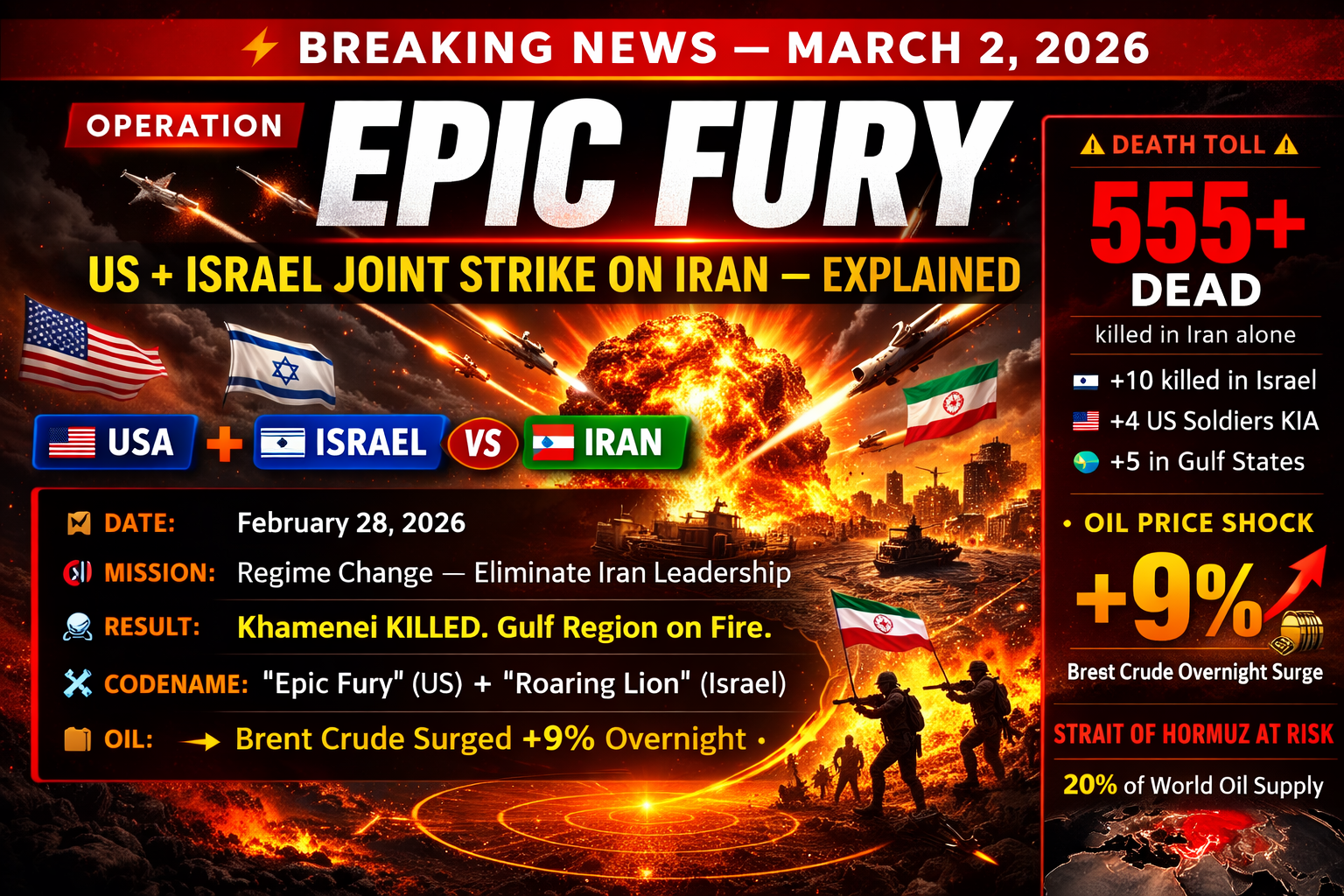
In short: On February 28, 2026, the US and Israel launched one of the biggest military strikes in modern history against Iran. The US called it “Operation Epic Fury.” Israel named it “Operation Roaring Lion.” Here’s everything explained simply.
What Is Operation Epic Fury?
Operation Epic Fury is the official name given by the US Pentagon to a massive joint military strike launched by the United States and Israel against Iran on February 28, 2026.
The operation was codenamed Operation Roaring Lion by Israel and Epic Fury by the US Department of Defense. It targeted key officials, military commanders, and facilities, and was aimed at regime change — including the assassination of Iran’s Supreme Leader Ali Khamenei.
Why Are There Two Operation Names?
Many readers are confused seeing two names in the news. Here’s the simple answer:
| Name | Named By | Country |
|---|---|---|
| Operation Epic Fury | US Pentagon | United States |
| Operation Roaring Lion | Israeli Defense Forces | Israel |
Both names refer to the same joint operation — different internal codenames for the same coordinated strikes.
What Happened on February 28, 2026?
Waves of Tomahawk and air-launched missiles eliminated Iranian air defenses and military sites Wikipedia in a surprise daytime attack. The biggest result: Iran’s Supreme Leader Khamenei was killed. US President Donald Trump confirmed the assassination and urged Iranians to take over their government.
Why Did the US and Israel Attack Iran?
Since Iran became an Islamist theocracy in 1979, it has adopted an anti-American stance, called for Israel’s destruction, allegedly developed a military nuclear program in secret, and supported anti-Western proxies across the Middle East. US forces have clashed with Iranian-backed militias in Iraq and Syria. Israel and Iran fought a 12-day war in June 2025 that also saw US strikes aimed at destroying Iran’s nuclear facilities.
The US presented Iran with three core demands: a permanent end to all uranium enrichment, strict limits on Iran’s ballistic missile programme, and a complete halt to support for proxy groups such as Hamas, Hezbollah, and the Houthis.
What Were the Key Targets?
According to reports, the operation struck:
- Iranian Supreme Leader Khamenei — killed
- Around 40 Iranian officials were reportedly killed in the strikes.
- Iranian air defense systems — destroyed
- The United States sunk an Iranian military vessel identified as a Jamaran-class corvette.
What Did Iran Do in Response?
Iran launched massive retaliatory strikes across the region. Iran’s Foreign Ministry stated the military lost control over several units, operating according to old general instructions.
What Is the Death Toll?
Preliminary figures show 555 killed in Iran, at least 10 in Israel, four US soldiers, and five killed in Gulf states.
How Did the World React?
China called the attacks “unacceptable” and demanded an immediate ceasefire, while Russia’s Putin called Khamenei’s killing a murder committed in cynical violation of international law. The UN Secretary General condemned the attacks, stating that the use of force by the US and Israel against Iran, and Iran’s subsequent retaliation across the region, undermine international peace and security.
Oil Prices & Global Economy Impact
The conflict shocked global markets. US crude oil surged over 8% and Brent jumped about 9% as traders feared major oil supply disruptions — particularly if Iran moves to block the Strait of Hormuz, through which roughly 20% of the world’s oil passes daily.
Summary in 5 Points
- Feb 28, 2026 — US and Israel launched a massive surprise attack on Iran
- Iran’s Supreme Leader Khamenei was killed in the strikes
- Iran retaliated by striking Gulf countries including Dubai, Kuwait, and Saudi Arabia
- Global oil prices surged; flights were grounded across the region
- The world watches to see if this escalates into a wider war — or forces regime change in Iran
Also Read