
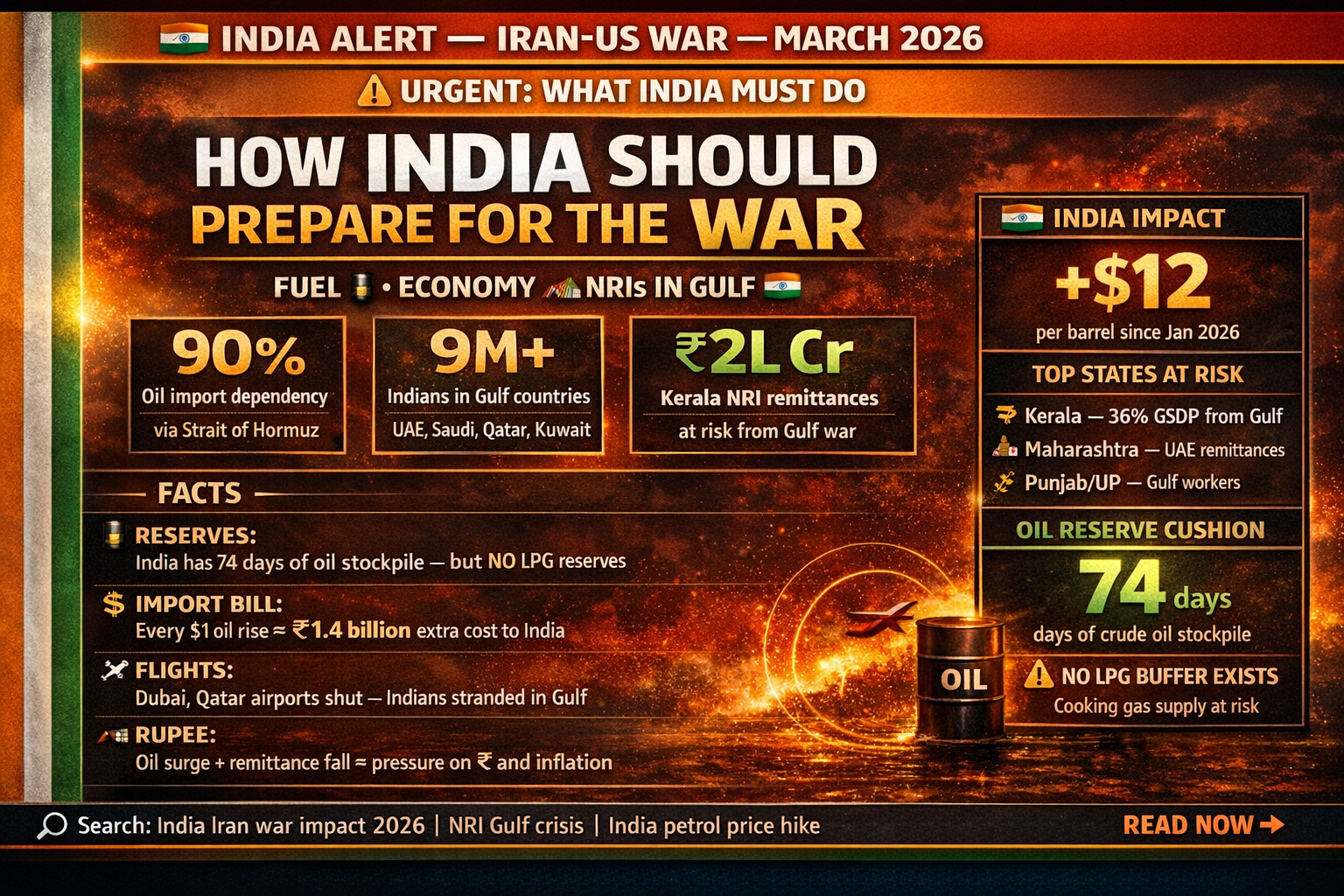
Why this matters to every Indian: India imports nearly 90% of its crude oil. Over 9 million Indians live and work in Gulf countries. Remittances from the Gulf finance nearly half of India’s trade deficit. The Iran-US war is not a distant conflict — it is hitting Indian homes, wallets, and families right now.
The War Has Already Reached India’s Doorstep
On February 28, 2026, the United States and Israel launched a massive joint strike on Iran, killing Supreme Leader Khamenei. Iran retaliated by striking Gulf nations including the UAE, Saudi Arabia, Kuwait, and Qatar — countries where millions of Indians live and work.
India imports nearly 85% of its crude, equivalent to roughly 4.2 million barrels per day, and even a few dollars’ increase in prices can materially affect the country’s energy economics.
This is not just a geopolitical story. For India, it is a story about petrol prices, cooking gas, jobs, remittances, the rupee, and the safety of millions of citizens abroad.
India’s Fuel Crisis — The Three-Pronged Problem
India does not just depend on the Gulf for crude oil. The dependency goes three layers deep.
India’s reliance on foreign fuels stands at 90% for crude oil, over 66% for LPG, and over 50% for LNG, according to oil ministry data. Wikipedia
These are not abstract numbers. They translate to:
Crude Oil — petrol, diesel, aviation fuel, plastics, and virtually every manufactured product you use daily.
LPG (Cooking Gas) — the cylinder your family uses to cook every meal. Nearly all of India’s LPG comes from West Asia, used for cooking by most Indian households in urban centres. Wikipedia
LNG (Natural Gas) — powers factories, generates electricity, and heats industrial furnaces across the country.
All three flow through or near the Strait of Hormuz — the narrow waterway Iran is now threatening to close.
India’s Oil Reserves — How Long Can We Last?
The question every Indian is asking: do we have enough stockpile to survive this?
According to Oil Minister Hardeep Singh Puri, India’s oil reserves in 2026 can last for 74 days. This includes stocks in strategic caverns, refineries, and floating platforms.
Here is how those reserves are stored:
Strategic Petroleum Reserves (SPR): Underground caverns managed by the Indian Strategic Petroleum Reserve Limited (ISPRL) in Visakhapatnam, Mangaluru, and Padur — good for approximately 9.5 days on their own.
Refinery Inventories: Crude and finished product stocks held by Indian oil marketing companies like IOC, BPCL, and HPCL.
Floating Storage: Oil held in tankers anchored at Indian ports.
The combined total gives India a 74-day cushion. While the International Energy Agency recommends a 90-day reserve, the government maintains that 74 days is a safe threshold for the current economic pace, though plans to expand to 90 days are underway.
The LPG gap is a serious concern. Unlike crude oil, India currently lacks large-scale strategic storage for LPG. This makes the country more vulnerable to supply shocks from the Gulf, where 80% of its LPG is sourced.
What Happens to Petrol and LPG Prices?
For every $1 increase in the price of a barrel of oil on the international market, India’s oil import cost increases by approximately $1.4 billion.
Brent crude has surged by over $12 per barrel since the start of 2026 due to regional tensions. That alone adds roughly ₹16,000–20,000 crore to India’s annual import bill.
What does this mean at the pump?
| Oil Price Scenario | India’s Annual Extra Cost | Likely Petrol Price Impact |
|---|---|---|
| +$10/barrel | ~₹14,000 crore | Petrol up ₹2–3/litre |
| +$20/barrel | ~₹28,000 crore | Petrol up ₹5–7/litre |
| +$40/barrel ($100+ Brent) | ~₹56,000 crore | Petrol up ₹10–15/litre |
Fuel prices will increase, which will lead to higher petrol, diesel, and LPG prices. The logistics industry will impose higher costs for freight-intensive products, which will raise their market prices. NPR
India’s Pivot to Russian Oil — The Smart Move?
India has a lifeline that most other Asian nations do not: access to discounted Russian crude.
In February 2026, India’s oil imports hit the second-highest ever at 5.22 million barrels per day, with Russia’s share at just 20% and West Asia surging to 51%. Wikipedia Before the war, Russia had been contributing significantly more.
India faces the most acute near-term exposure and is likely to pivot towards Russian crude immediately, given proximity and established logistics.
If Gulf supplies are disrupted but Russian exports continue — even with longer routes around Africa, increased freight and insurance — India can continue to receive supplies, as Russian ports do not depend on Hormuz. Wikipedia
However, there is a diplomatic risk. India’s oil purchases will be under the microscope if it buys additional Russian oil cargo, as Washington may pressure New Delhi to reduce Russian energy dependence as part of broader US-India relations.
The NRI Crisis — 9 Million Indians in the Line of Fire
This is the most personal dimension of the war for millions of Indian families.
India has deep economic and people-to-people ties with Iran and key Gulf countries such as the UAE, Saudi Arabia, Qatar, Kuwait and Bahrain. These links span oil supplies, trade, investments, remittances, and millions of Indian workers and students living there. PBS
The numbers are staggering: over 3.4 million Indians live in the UAE alone, with millions more across Saudi Arabia, Qatar, Kuwait, Oman, and Bahrain.
Flights Are Grounded
Many Indians in the Gulf are now stranded. Dubai International Airport suspended operations after Iranian missile strikes hit the UAE. Qatar Airways grounded all flights. Air India and IndiGo suspended Gulf routes. Families trying to reach loved ones — or loved ones trying to come home — face closed airports and no confirmed timelines.
Jobs and Salaries at Risk
If military escalation disrupts oil installations, port operations or business activity in the GCC, employment contracts may be suspended or terminated. Even temporary delays in salary payments can ripple through Kerala’s financial system. Bank deposits could slow. Loan repayments might falter. Consumer spending may contract.
Kerala — The State That Feels It Most
No Indian state is more exposed to this crisis than Kerala.
Annual remittances sent by Non-Resident Malayalis to Kerala have crossed ₹2 lakh crore for the first time, and NRI deposits in banks across the state have crossed ₹3 lakh crore. cfr
Kerala accounts for 19.7% of the country’s total remittance inflows. cfr
Kerala’s post-1970s social transformation is inseparable from Gulf migration. Lakhs of Malayalis work across Saudi Arabia, the UAE, Qatar, Oman, Kuwait and Bahrain in construction, oil and gas, healthcare, retail, logistics, hospitality and domestic services. Remittances sent back home have underwritten household consumption, private education, real estate growth and banking deposits across districts from Kasaragod to Thiruvananthapuram.
On the day retaliatory reports began circulating, social media timelines were flooded with anxious messages. WhatsApp groups of families with relatives in Dubai, Doha or Dammam lit up with questions. Airline websites were checked repeatedly.
Kerala has confronted this scenario before — during the 1990–91 Gulf crisis, when large numbers of expatriates were evacuated. But the scale today is far larger, and the economic dependency far deeper.
The Rupee, Inflation & Stock Market Impact
The economic pressure does not stop at fuel prices.
Rising oil prices will weigh on the balance of payments and could put further pressure on the rupee.
Higher crude prices increase inflation and put pressure on the rupee. Energy-driven inflation could complicate central bank strategies. Higher fuel costs increase production and logistics expenses worldwide.
India’s remittance inflows have more than doubled from $55.6 billion in 2010-11 to $118.7 billion in 2023-24. These inflows finance nearly half of India’s merchandise trade deficit and help cushion external shocks. PBS Any disruption to Gulf remittances directly widens India’s current account deficit.
On the stock market, the impact is mixed: energy stocks surge, aviation stocks fall, and broader indices face volatility as inflation fears mount.
What Should India Do? A 5-Point Action Plan
Here is what India should be doing right now — and what you as an individual can do:
For the Government:
- Immediately activate emergency procurement of Russian crude at discounted rates to replace Gulf supplies
- Release LPG buffer stocks and communicate clearly to avoid panic buying
- Activate the Operation Kaveri-style evacuation framework for Indians in conflict zones
- Negotiate with Gulf states to protect Indian worker contracts from unilateral termination
- Engage diplomatically with both Washington and Tehran to protect Indian interests
For NRIs in the Gulf:
- Register with the Indian Embassy or Consulate in your country immediately
- Keep your passport, visa documents, and emergency contacts accessible at all times
- Maintain at least 2 weeks of food, water, and medicines at home
- Download and monitor the Indian government’s eMigrate and MADAD helpline apps
- Have a contingency plan for evacuation — know the nearest Indian Embassy
For families in India:
- Do not panic-buy fuel or LPG — India has a 74-day reserve cushion
- Avoid speculative investment decisions based on daily news volatility
- Consider increasing savings as a precaution against possible inflation
Summary: What the Iran-US War Means for India in 5 Points
- Fuel risk is real but manageable short-term — India has 74 days of oil reserves and can pivot to Russian crude
- LPG is the most vulnerable — India has no strategic buffer for cooking gas
- Every $1 rise in oil adds ₹1.4 billion to India’s import bill — $12+ spike is already hurting
- 9 million+ Indians in Gulf face job, salary, and safety uncertainty
- Kerala faces the deepest shock — ₹2 lakh crore in annual remittances at risk
India is not at war — but the war is very much at India’s doorstep.
Disclaimer: This article is written for informational and educational purposes based on publicly available reports as of March 2, 2026. It does not constitute financial, investment, or evacuation advice.
Read Also
Компания предоставляет официальную гарантию на продукцию и установку, что защищает клиентов от непредвиденных проблем.
Компания «Пластик» предлагает производитель пластиковых окон отличного качества с гарантией и профессиональным монтажом по Москве.
Компания «Пластик» предлагает купить пластиковые окна хорошего качества в Москве, сочетая надежность и доступные цены.
I started writing down one thing at the end of every day — what I actually managed to do. Not a to-do list, not plans. Just one small win. It’s surprising how quickly it shifts your perspective.
Открой для себя азарт и выигрыши вместе с 7 к казино.
Наличие аудиторских заключений и сертификаций повышает уровень доверия со стороны игроков.
Создание аккаунта на официальном сайте 7к казино проходит быстро и требует минимальной информации.
Посетите 7 казино для быстрого доступа к играм и бонусам.
Комментарии и оценки пользователей учитываются при совершенствовании платформы.
Для привилегированных клиентов организуются специальные мероприятия и уникальные предложения.
Юридическая информация и лицензии представлены на официальном сайте для проверки прозрачности деятельности.
Игры проходят сертификацию, чтобы обеспечить честность и случайность результатов.