
The most important thing to understand: The Strait of Hormuz is not just an oil pipeline. It is the supply chain for your entire life — the fertiliser on your farm, the plastic in your phone, the gas in your power plant, and the aluminium in your kitchen. And right now, it is effectively closed.
The Crisis: Where Things Stand Today (May 15, 2026)
Key developments as of mid-May 2026:
- 1,550+ vessels stranded, 22,500 mariners trapped — confirmed by the Chairman of the US Joint Chiefs of Staff on May 6. The International Maritime Organization puts the figure at up to 2,000 vessels.
- Traffic through Hormuz is running at approximately 5% of its pre-war average, according to vessel transponder data published by Kpler.
- Brent crude has surpassed $114 per barrel, with spikes above that level during active military exchanges. The largest single monthly increase in oil prices in history occurred in March 2026.
- A fragile ceasefire announced April 8 has repeatedly frayed. On May 8, the US and Iran exchanged fire in the strait, pushing oil prices up nearly 6% in a single day and raising fears the ceasefire would collapse entirely. President Trump paused his “Project Freedom” naval escort mission on May 6 but the strait remains effectively closed to commercial traffic.
- Iran redefined the strait — In May 2026, Iran’s IRGC Navy declared the Strait of Hormuz a “vast operational area” extending far beyond the traditional narrow corridor, from the port city of Jask to Siri Island. This dramatically widens the zone of risk.
- The UK has deployed drones, fighter aircraft, and a Royal Navy warship to participate in an international defensive mission aimed at protecting commercial shipping.
- The UN Secretary-General has called the situation an emergency, warning that “any restart of the fighting would have terrible consequences.”
The IEA has described this as the “greatest global energy security challenge in history.”
PM Modi’s National Appeal: India Mobilises for the Long Haul
In one of the most significant political responses to the crisis from any major economy, Indian Prime Minister Narendra Modi addressed the nation — speaking at a function in Hyderabad — and made seven direct appeals to Indian citizens to change their economic behaviour.
His statement came as crude oil was trading above $100 per barrel, with a 52-week high of $126 per barrel recorded at the end of April 2026, and with the Hormuz blockade entering its 75th consecutive day.
Modi said:
“In this time of global crisis, we have to make a resolution, keeping duty paramount, and fulfill it with complete dedication. A big resolution is to use petrol and diesel sparingly. We must curb our use of petrol and diesel.”
His seven specific appeals to Indian citizens were:
- Conserve petrol and diesel — use public transport, carpool, reduce unnecessary travel
- Revive work-from-home — “We must prioritize work from home, online conferences, and virtual meetings again,” he said, echoing pandemic-era policies
- Avoid foreign travel for one year — including destination weddings abroad
- Do not buy gold for one year — to conserve foreign exchange as import costs surge
- Reduce edible oil consumption by 50% — to reduce dependence on imports and improve public health
- Save foreign exchange — by cutting back on all non-essential imports
- Reduce chemical fertiliser use by half — and shift toward natural farming to reduce dependence on imported urea and phosphates
Modi framed the appeal as a matter of economic patriotism, drawing a connection between individual consumer choices and national resilience. “Some minor changes should be done for one year to save large amounts of foreign exchange,” he said.
The appeal was not without political controversy. Congress leader Rahul Gandhi and Samajwadi Party chief Akhilesh Yadav characterised it as evidence of government failure. Supporters of the government argued the appeal reflected prudent long-term thinking, not crisis management failure.
India is among the most exposed nations in the world to this crisis — it imports nearly 40% of its crude oil and approximately 90% of its LPG requirements, much of it from the Gulf.
You May Not Live Near the Gulf. But the Gulf Lives in Your Home.
Most people think the Strait of Hormuz crisis is a problem for oil companies and governments. It is not. It is a problem for your grocery bill, your next phone upgrade, your monthly electricity payment, and the cost of medicines your family depends on.
Here is how a 21-mile waterway thousands of miles away is already changing the price of things you buy every single day.
🥦 Your Vegetables Are Getting More Expensive
This surprises most people. How does a war in the Middle East raise the price of tomatoes, onions, and potatoes at your local market?
The answer is fertiliser.
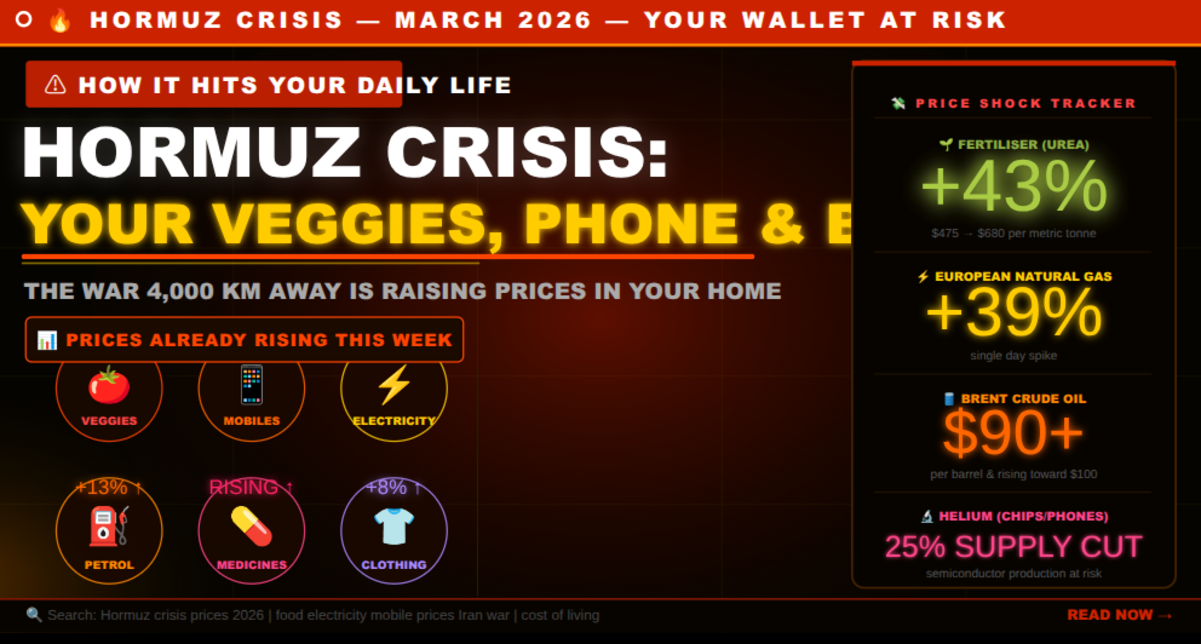
About 33% of the world’s fertilisers — including sulphur and ammonia — travel through the Strait of Hormuz. Qatar, Saudi Arabia, Oman, and Iran together supply a substantial share of the world’s traded urea and phosphates, and virtually all of it transits Hormuz.
When fertiliser gets stuck on tankers that cannot move, farmers face a choice: pay far more for what little is available, or use less and grow less. Both options end with higher food prices for you.
Urea fertiliser prices at the New Orleans hub spiked 43% in the early days of the crisis — from $475 to $680 per metric tonne — and have remained elevated. This came at the critical spring planting window for soy and corn in the northern hemisphere, meaning farmers were buying fertiliser precisely when it had become most scarce.
Update (May 2026): Fertiliser shortages have now been running for more than two months, meaning the impact on yields will begin showing up in global food production data by mid-year. PM Modi’s appeal for Indian farmers to cut chemical fertiliser use by 50% reflects both a practical response to a real shortage and a longer-term push for domestic agricultural self-reliance.
What it means for your trolley: Onions, tomatoes, potatoes, cooking oil, and grain-based products are already costing more. Countries with high food import dependency continue to feel it hardest.
📱 Your Next Phone or Laptop Will Cost More
Your smartphone contains aluminium, plastics, rubber, and rare components — almost all of which are affected by the Hormuz shutdown.
Aluminium: The Middle East accounts for roughly 8–9% of global aluminium output, and many smelters rely on raw materials imported through the strait. Aluminium Bahrain has invoked force majeure on some shipments. Aluminium is in everything: smartphones, laptops, tablets, cars, kitchen appliances, construction materials, and packaging.
Plastics and Petrochemicals: About 85% of polyethylene exports from the Middle East travel through this route. Your phone case, charging cable, and product packaging are all made from petrochemicals transiting Hormuz.
Helium — The Hidden Semiconductor Crisis: More than a quarter of the world’s helium supply has been cut off. Helium is essential for manufacturing semiconductors — the chips inside every phone, computer, car, medical device, and smart appliance. A helium shortage doesn’t just raise prices; it can halt production lines entirely. This is still the aspect of the crisis that receives the least public attention, but its effects on consumer electronics will be felt for months after the strait reopens.
What it means for your tech purchases: Phone and laptop prices are already rising 5–15% in some markets. Component shortages are extending delivery times. If you were planning a large electronics purchase, prices have already moved higher than they were in February.
💡 Your Electricity Bill Is Going Up
This is the most direct hit for most households. The connection between the Strait of Hormuz and your electricity bill runs through natural gas.
Qatar — the world’s largest LNG exporter — declared force majeure on all LNG shipments after Iranian attacks on its Ras Laffan facilities on March 4, 2026. European natural gas prices jumped 39% in a single day at the crisis onset.
Update (May 2026): The electricity crisis has deepened significantly. Parts of South Asia have been experiencing power cuts of up to six hours per day. European utilities have sharply increased imports of Russian LNG from the Yamal project in the Russian Arctic — the EU received 91 cargoes from Yamal LNG between January and April 2026, accounting for approximately 98% of the facility’s exports during that period. This represents a record £3bn in Russian LNG imports, a troubling reversal for Europe’s energy independence goals.
Every 10% increase in oil prices — sustained for most of a year — pushes global inflation up by 0.4 percentage points and reduces worldwide economic output by as much as 0.2%, according to the IMF.
What it means for your electricity bill: Unit prices have already risen in countries dependent on imported gas. India, Pakistan, Bangladesh, and most of Europe have seen the sharpest increases. This is unlikely to reverse quickly: even after the strait fully reopens, analysts estimate it could take up to three months for energy flows to normalise.
👕 Your Clothes Will Cost More Too
The Asian garment industry relies on petrochemicals shipped through the Strait to produce synthetic fabrics like polyester, nylon, and spandex. Bangladesh — the world’s second-largest garment exporter — is being hit on two fronts: rising energy costs shortening factory shifts, and disrupted shipping routes delaying raw materials and finished goods.
Your next clothing order will likely arrive later and cost more.
💊 Medicines and Medical Equipment
Pharmaceuticals are under direct stress from the disruption. Many active pharmaceutical ingredients are petrochemical-derived and manufactured in or transported through the Gulf. Medical equipment — from disposable plastic syringes to aluminium surgical tools — is similarly exposed. Hospitals in import-dependent countries are reviewing inventory buffers.
🍚 Your Rice, Coffee, and Red Meat
About 400,000 tonnes of Indian basmati rice were stranded at ports or aboard ships in the early weeks of the crisis. Cargo carrying Australian meat and Indonesian coffee has been delayed or forced onto longer, more expensive routes.
Soybean oil — used widely in cooking and industrial food production — was among the first food products to spike in price. This has not reversed.
🚗 Transport, Fuel & Everything Downstream
War-risk insurance premiums for ships attempting to transit the Gulf surged dramatically at the crisis onset and have remained elevated throughout. Every day that ships sit idle — and there are now over 1,550 of them — goods that should be reaching shelves are not.
Update (May 2026): On May 4, President Trump launched “Operation Project Freedom,” a US Navy mission to escort merchant ships out of the Gulf using over 100 aircraft and 15,000 service members. The market was unimpressed: oil prices rose, not fell, in response. Iran declared it a ceasefire violation and resumed attacks. Trump paused the operation on May 6 citing “great progress” in negotiations, but the strait remains effectively closed. Shipping executives have expressed caution about whether tanker owners will risk transit even with a naval escort.
How Long Until This Hits Your Wallet?
Timeline updated for May 2026 reality:
| Timeframe | What’s Happening Now |
|---|---|
| Already happened | Petrol, diesel, cooking gas, vegetable oils up significantly; power cuts in parts of South Asia; airline fuel surcharges |
| Weeks 1–8 (done) | Vegetables, transport fares, rice, dairy all up; electricity bills rising |
| Now ongoing | Electronics prices rising; appliance delivery delays; medicine costs increasing; clothing costs rising |
| If closure lasts to mid-2026 | Crop yield impacts from fertiliser shortages become visible in food prices; potential stagflation in import-dependent economies |
What Can You Do Right Now?
Practical steps for households — updated for May 2026:
Conserve fuel. PM Modi’s advice applies beyond India. Reducing discretionary driving and unnecessary heating and cooling directly reduces your exposure to rising energy costs.
Consider work from home where your employer allows it. Multiple governments — India, Thailand, and others — are encouraging this as a fuel conservation measure.
Review your grocery spending. Cooking oils, grains, and packaged foods have all risen. Staple buying in normal household quantities at current prices is reasonable.
Defer large electronics purchases if possible. Prices are already higher than they were in February, and component shortages mean availability is constrained too.
Do not panic-buy. Panic buying creates the very shortage it tries to avoid. Governments and supply chains have buffer stocks.
Watch energy tariff notices. Many utility suppliers reprice contracts on rolling windows. Check whether your contract rate is about to reset.
The Bottom Line
The Strait of Hormuz crisis is no longer a disruption. It is, by the IEA’s own description, the greatest global energy security challenge in history — larger in scale than the 1970s oil embargo that reshaped the world economy.
The ceasefire announced in April has held loosely but is under constant strain. The US and Iran exchanged fire as recently as May 8. Over 1,550 ships remain trapped. Traffic through the strait is running at 5% of normal. Oil is above $100 per barrel. And even if a durable peace agreement were signed tomorrow, analysts say it would take months for energy flows and supply chains to normalise.
India’s Prime Minister Modi asking citizens to stop buying gold, cut fuel use, and work from home is not a signal of panic. It is a signal of how serious and prolonged this crisis has become.
The war may be between governments and militaries. But the bill — as always — is paid by ordinary people, one grocery trip, one electricity payment, and one petrol fill-up at a time.
Also Read: Chabahar vs IMEC: Which Trade Route Survives the Iran War?
Disclaimer: This article is written for informational purposes based on publicly available reports as of March 13, 2026. It does not constitute financial or investment advice.